AI-assisted software development

Turn a good software idea into something people can actually use.

Tell us what you’re trying to fix or improve. We’ll help you figure out what software would actually help—and whether it is worth building at all. If it is, we’ll plan it and build it.

We use AI to move faster and check the work, but people stay in charge of the important choices.

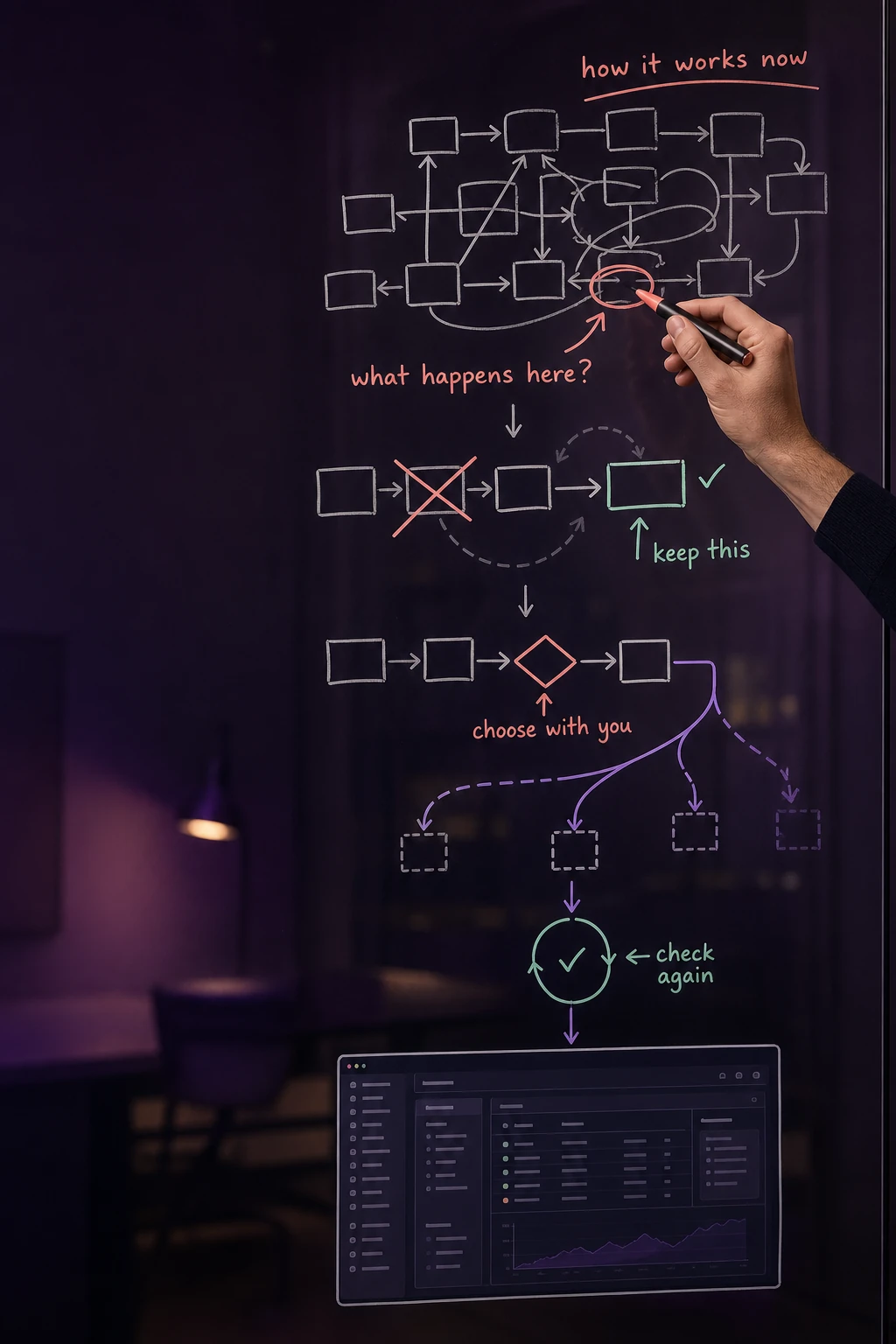
A hand investigates the current workflow, preserves what works, makes a shared choice, checks the route and turns it into useful software.

When Koelle can help

Does any of this sound familiar?

The idea has promise. It needs to become something people can actually use.

You may have notes, sketches or an early concept. Now it needs clear choices, thoughtful design and proper development.

The prototype looked good. Real use is exposing problems.

Demonstrations went well, but real users, real information or ordinary changes are showing that the software is not as dependable as it appeared.

The release is getting close. Confidence is not.

The main features are working, but nobody has enough evidence to say what is ready, what needs attention or what should stop the release.

The AI feature sounds convincing. You are not sure when to trust it.

It works well with simple examples, but answers may change, important information may be missed or the system may sound certain when it should ask a person for help.

Sometimes the answer is to build something new. Sometimes it is to rescue what you already have. And sometimes you need to know whether the software is ready. We do all three.

How Koelle can help

You do not need to have everything figured out.

You might have an idea that needs shaping, software that is causing problems, or a product you are unsure about releasing. We help you understand what is happening, decide what makes sense and move forward with a clear next step.

01

AI-assisted software development

Decide what is worth building. Then bring it to life.

You might arrive with a detailed plan, a rough idea or simply a problem that software could solve. We’ll help you decide what makes sense, then take it through design and development. We can build a prototype, one part of a larger system, an MVP or a complete product.

We use AI to help us move faster and check the work as we go. It can review code, help create tests and point out missing or inconsistent behaviour. People decide what gets built, judge the results and decide what is ready to use.

See the service in practice
Anonymised case study

A field-service mobile app

A property-maintenance company coordinated repair visits through calls, messages and paper job sheets. Koelle helped define and build a focused mobile product for assignments, arrival, photographs, reporting work that could not be completed and recording completed jobs—without turning the first version into a full field-service platform.

The result: a usable MVP field-tested with 20 field workers and improved using their feedback.
Anonymised case study

A learner mobile app

A training provider already had working enrolment and administration systems. Koelle added a focused mobile experience for course schedules, preparation tasks, venue changes, notifications and an attendance pass.

The result: Koelle's work was tested with representative users, packaged and incorporated into the provider's wider application for the focused learner journeys it was designed to handle—without replacing systems that already worked.

Discuss new software →
02

Software and prototype rescue

The software is struggling. Let’s find out why.

Maybe the software looked promising at first. But it has become unreliable and hard to change. Important steps fail. Changes cause new issues. Some parts may still be useful, though.

We look at what the software is supposed to do, what is actually going wrong and what can be kept. Then we help you choose whether to repair it, rebuild the weak parts, replace it or stop. If recovery makes sense, we can carry out the agreed repair or rebuilding work.

See the service in practice
Anonymised case study

A customer portal that worked only with help

A property-services portal looked complete, but reports appeared twice, large photographs failed and staff quietly returned to email and spreadsheets. Koelle examined the important journeys, retained the useful parts and rebuilt the unreliable submission path.

The result: the repaired path was piloted successfully and made part of the client's wider release.
Anonymised case study

An AI-generated prototype that was not yet a product

A report-writing prototype proved the idea but produced inconsistent drafts and had weak traceability. Koelle used AI-based tooling to improve the report pipeline, added automated quality gates and securely built the organisation's required human approval into the workflow.

The result: more consistent outputs, improved traceability and secure human approval before reports could proceed.
Discuss existing software →
03

Software quality and AI evaluation

Ready to release—or just ready for another test?

The team has built the software. The main features are working. Now someone has to decide whether real users should depend on it. A polished demonstration cannot answer that question.

We put the software through rigorous testing using the journeys and difficult situations that matter. If it uses AI, we also look for wrong, inconsistent or overconfident answers and decide where a person needs to step in. You get practical findings that show what can go ahead and what needs attention first.

See the service in practice
Anonymised case study

A business-portal release review

A logistics company was unsure whether its internal portal was ready for everyday use. Koelle tested important journeys, roles, incomplete information and connected-system failures, then separated release blockers from later improvements.

The result: management received clear evidence to delay the full rollout, correct the release blockers and begin with a smaller user group.
Anonymised case study

An AI document-intake evaluation

An insurance-services company needed to process claim documents with AI without letting uncertain results pass unchecked. Koelle built the workflow that ran the AI extraction, sent uncertain cases to a person for review and combined the results at the end. We then used clean, damaged and ambiguous examples to find where the workflow worked and where confidence was misleading.

The result: a working document-intake workflow that ran AI extraction, routed uncertain cases for human review and combined both sets of results into a final reviewed output.
Discuss quality or release confidence →

Whichever service you need, using AI is only part of the answer.

More than AI-generated code

AI can help almost anyone start. Good software still takes judgement.

AI can produce code quickly and turn a rough idea into a convincing demonstration. But it does not know your business, understand the people who will use the software or decide what is worth building.

That is where Koelle starts. We get clear about the problem, plan the work and make the important design choices before speed takes over. Then we use AI throughout development to move faster and check the work. People remain responsible for what gets built, how well it works and whether it is ready for real use.

01

Understand the real problem before building gathers momentum

02

Decide what is worth building—and what is not

03

Plan and design the work before speed takes over

04

Use AI throughout development without handing it the important choices

05

Check the work and keep the next decision visible

AI makes software easier to start. Koelle helps make it worth building and fit for real use.

Is Koelle a good fit?

You do not need all the answers. You do need a real reason to build.

Some customers arrive with a clear plan. Others arrive saying, “We think we need AI,” but are still working out why. Both are reasonable places to start. We’ll help you get to the problem underneath the idea.

A good place to start

  • Something in the business, product or customer experience needs to improve.
  • You know who is affected, even if the right answer is not clear yet.
  • The people who understand the situation can help us make important choices.
  • You are open to starting with a focused piece of work instead of building everything at once.
  • You want to move quickly without giving up usefulness, quality or ownership.

What we may challenge

  • If “we need AI” is the whole brief, we’ll ask what should become easier, faster or better.
  • If the first plan is too large, we may suggest a smaller way to test the important part.
  • If a quick demonstration is being treated as finished, we’ll explain what still needs to happen.
  • If speed is pushing aside privacy, reliability or quality, we’ll make the risk visible.
  • If the evidence points away from further development, we’ll say so.

Then we get to work—starting with what needs to change and what we need to achieve first.

What happens next

Start with the situation. Work out the right next step together.

Whatever kind of help you need, you should always know what we are doing, why it matters and what happens next.

Before the work starts

Tell us what is happening

Tell us what is happening and why it matters. We’ll arrange a first conversation to understand the broad situation and see whether Koelle may be able to help. If there is a sensible fit, we’ll agree any deeper discovery, assessment or delivery work before it begins.

  1. 01

    Understand what needs to change

    We take what we heard in the first conversation and look more closely at what needs to improve, who it affects, what has already been tried and why it matters now.

  2. 02

    Look at the whole picture

    We learn how the work happens today and examine the people, software, information and evidence involved. For rescue work, that includes looking at what already exists. For quality work, it includes deciding what needs to be tested.

  3. 03

    Agree what a useful result looks like

    Together, we decide what this piece of work should achieve, what is included, who needs to be involved and what will be handed over at the end.

  4. 04

    Do the work and show progress

    We design, build, examine, repair or test—depending on the service. You see progress at useful points, so important choices do not disappear inside the project.

  5. 05

    Leave the next move clear

    The next move might be to launch, repair, rebuild, expand, hand over, arrange further support, pause or stop. The evidence from the work helps you make that choice.

The aim is not to make every engagement follow the same formula. It is to keep the problem, choices and next step clear throughout the work.

Start a conversation

Have something in mind? Start with a short message.

Tell us what is happening, who it affects and why it matters now. You do not need a finished specification or a proposed solution. Please do not include passwords, confidential records or other sensitive information in your first message.

Primary contactriffat.alim@koelle.online Alternative contactsalim.ahmed@koelle.online

Please do not include passwords, access credentials, confidential client data or other sensitive information.

This prepares an email in your own email application. Koelle receives nothing until you review and send it.